[eng] Foucault claims that the modern school is like a prison. Is he right?

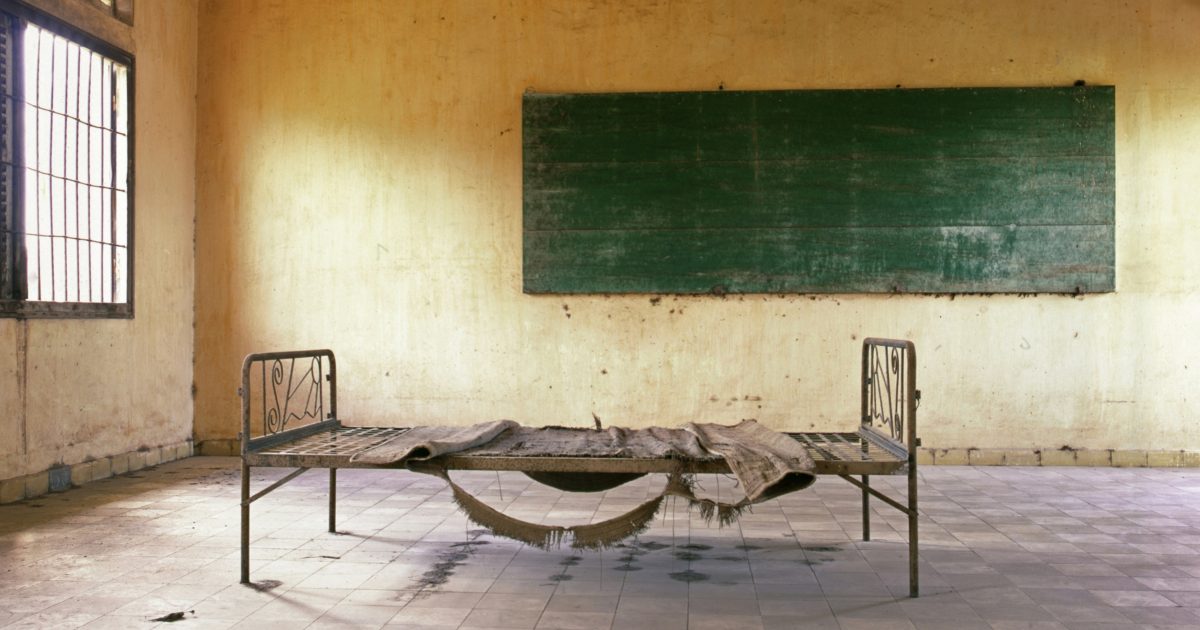
In this essay, I shall argue that Michel Foucault’s argument that the modern school is like a prison is true, as long as the context is properly clarified. First, I shall show that Foucaul’t comparison is relevent in order to discuss structures of power. Second, I will demonstrate that this same statement could be absurd if it was seen as an absolute, and not as a sentence within Foucault’s workframe. Third, I argue that the fact that I agree to the French philosopher’s argument to a certain extent doesn’t mean I think he is ‘right’ in a straightforward sense. Therefore, I conclude that my answer to the asked question, as it is phrased, would not be a mere affirmation or rejection, but rather a careful qualification.
First, to understand why Foucault compares the modern school to a prison, we must examine his concept of discipline, a fundamental mechanism of power that structures both institutions.
Foucault tackles the notion of discipline, which constitutes an entire chapter of his work Discipline and Punish (1975). It is through this concept of discipline that the philosopher draws a comparison between prison and the modern school. For Foucault, discipline is ‘a type of power.’ This type of power, vast in its complexity and diversity, consists of observing, supervising, and punishing with the aim of correcting and reforming. Thus, based on this definition developed by the French thinker, both prison and school are disciplinary institutions. Let’s begin by examining the school. The modern school, the one Michel Foucault examines, is the French school that emerges from the 18th century onwards. This institution first functions as a disciplinary structure. Time is strictly organized according to a timetable, which is often dense. The disciplinary nature is evident here: the student studies subjects they have not chosen, with a schedule designed to make these subjects the central and most significant part of their day. Students are systematically monitored—by the supervisor, by the prefect, by the teacher. Based on their academic performance and behavior, they are classified and ranked. Seated next to one another, in rows, each student is defined by their position within a hierarchy. All of this serves a purpose of normalization and conformity: grading (through examinations), rules, and punishments shape acceptable behavior within a normated system.
Now, let’s compare school to prison. By its very nature, prison is the ultimate disciplinary institution. It’s a place of constant surveillance and punishment (on top of incarceration itself, which is already a form of punishment) with the goal of correcting and reforming. In fact, it’s by looking at prison that Foucault develops his model of disciplinary power. This model generally follows a set structure: most of the time, there’s an enclosure (clôture)—an isolated space, cut off from the outside world. There’s a strict system of organization (quadrillage)—each person has a designated spot, and every spot is occupied by someone. The space is arranged to maximize efficiency and to enforce strict separation (emplacement fonctionnel). The result? A living tableau, where individuals become interchangeable, nothing more than points in a web of control. In prison, this structure is obvious—it’s built into the system. But what about school? Looking at what we described earlier, we can see the same patterns. There’s an enclosure: in the modern school system, boarding schools and convents became more common. There’s strict organization: every student has their assigned seat, and every seat is filled. Classrooms are arranged in neat rows, with students facing the teacher. It’s a living tableau, a ‘serial space where each individual is monitored, and the whole group is observed at once’ (Foucault 1993: 166). All four conditions are met. We can push the comparison with prison even further—starting with the control of activity. Both institutions enforce a strict disciplinary order through schedules, which play a central role in structuring time. Another key similarity is the presence of an exam, a test with a triple function: it determines whether the individual (student or inmate) has reached the expected level, ensures the effectiveness of correction or learning, and differentiates individuals based on their abilities. The comparison can be extended even further to the very structure of both environments. Foucault describes the panoptic architecture of prisons, where cells are arranged in a circular formation around a central watchtower. This setup allows guards to see all prisoners with a single glance while preventing prisoners from knowing whether they are being watched (through lighting or optical illusions) and from seeing each other. A strikingly similar structure appears in the classroom: students are seated in rows, with the teacher positioned in a way that allows them to monitor the entire class, while students themselves can barely see each other. Finally, both institutions operate under a system of rules, punishments, and rewards, overseen by an authority figure—a judge in prison, a teacher in school. Foucault even describes the education system as a form of ‘infra-penality’, a subtler but deeply embedded system of discipline (Foucault 1993: 210)and argues that we live in a society of the ‘professor-judge.’ (Foucault 1993: 155). In fact, the education system and the prison system share the same objective. In prison, delinquents are corrected; in school too, but before they become so.
While I agree with Foucault’s comparison in that schools and prisons both aim to produce docile, obedient subjects, I also think that pushing the analogy too far or discussing it outside the context of Foucault’s work can be misleading.
Of course, this comparison should not be mistaken for an equivalence. Prisons are designed to isolate and punish, whereas schools (at least in theory) are meant to develop knowledge and critical thinking. In fact, Foucault makes it clear from the outset that in modern society, there is a strong link between knowledge and power. As sociologist Stephen J. Ball points out, unlike prison, ‘education works not only to render its students as subjects of power, it also constitutes them, or some of them, as powerful subjects.’ (Ball 2013: 5). Taking this comparison too literally would lead to a complete misunderstanding of Foucault’s perspective, reducing his analysis to an excessively deterministic view of education—something the philosopher outright rejects. He repeatedly states that he does not align with naturalist thought and refutes the idea of a fixed destiny. Moreover, Foucault’s argument is situated within a specific historical context: he is referring to the ‘modern school’. It would be a mistake to replace this 18th-century model with earlier Jesuit colleges or the contemporary education system. While these systems share the same fundamental finality—monitoring and influencing individuals to shape them according to a norm—they do not function in the same way or serve the same purposes. As a result, they do not exhibit the same disciplinary structures. For instance, the old Jesuit colleges brought together hundreds of students without any form of individualization—an essential aspect of disciplinary technology. Meanwhile, in contemporary education, we see an increasing number of alternative models (such as Montessori or Summerhill) that actively challenge the prison-like framework of traditional schooling.
Therefore, by decontextualizing the comparison, there is a risk of a rigid interpretation and of completely missing Foucault’s point. Indeed, in my understanding, Foucault’s aim is not to claim that school is a prison, but rather to show how power operates in both. I believe he seeks to expose hidden mechanisms of control, even within institutions that present themselves as neutral. As The Stanford Encyclopedia of Philosophy summarizes: ‘we should not […] think that the deployment of this model [comparison] was due to the explicit decisions of some central controlling agency. Foucault’s analysis shows how techniques and institutions, developed for different and often quite innocuous purposes, converged to create the modern system of disciplinary power.’ (Gutting and Oksala 2022). As a matter of fact, Foucault makes similar comparisons with other institutions—hospitals being perhaps the most recurrent example. He also describes the army and production workshops as technologies of power and discipline. If the phrase ‘modern school’ in the essay question had been replaced with ‘modern hospital’ or ‘modern workspace’, I could have likely written almost the same essay, simply swapping out the examples. In this sense, I agree with Foucault’s comparison, as long as we focus on the concept of the power mechanism. However, reducing education solely to a power mechanism means ignoring its complexity.
Finally, in order to fully engage with the question, it is crucial to distinguish between agreeing with Foucault’s critique and assessing whether he is objectively « right »—a distinction that complicates any straightforward answer.
To fully answer the question, it is necessary to clarify the arguments developed so far, as they do not entirely address the question as it stands. Indeed, the question is not ‘Do you agree with Foucault?’—in which case the answer would already be clear—but rather ‘Is Foucault right?’ That being said, providing a direct answer is not so simple. As we have explained, Foucault’s claim is a powerful critique, but it does not provide an absolute truth. His analysis is not a moral judgment on schools but an exploration of how power operates. As Ball states in his study, ‘the effects of power are both negative and positive.’ (Ball 2013: 5). Negative, because students are repressed, corrected, and shaped to fit a predetermined mold. Positive, because the power to which they are subjected also provides them with tools and access to power. To illustrate this second point, Ball refers to the ‘historic shift in gender relations in the 19th century’, which saw the emergence of a new professional and managerial ‘education-generated class.’ (Ball 2013: 5). To say that Foucault is simply ‘right’ would ignore the nuances of his work—his goal is to reveal structures of power, not to condemn schools as inherently evil. But to say that he is simply ‘wrong’ would be just as inadequate, precisely for the same reason.
In fact, the phrasing of the question is misleading if one aims to answer it precisely: ‘the modern school is like a prison’ suggests a total equivalence, which, as demonstrated, is inaccurate. It invites an emotional response, whereas Foucault’s analysis is (at least intended to be) structural and historical. As Professor Richard Jones emphasized in Ball’s book, Foucault is known for his total rejection of the notion of ideology, in contrast to other philosophers who also explored the relationship between knowledge and power—such as Marx, for example (Ball 2013: 93). With Marxism, one could argue whether the ideology is ‘right’ or ‘wrong’—but it is precisely for this reason that Foucault rejects ideology. As he puts it, ‘whether one wants it or not, [ideology] is always in virtual opposition to something like the truth’ (Foucault 1980). And when one claims that something is ‘right’ or ‘wrong’, it is necessarily in comparison to either a truth (accurate or inaccurate) or a moral framework (good or bad). For this essay, in both cases, it is therefore impossible to provide a definitive answer. Foucault’s comparison works as a critique of power structures, but it fails as a literal statement.To conclude, in light of the arguments presented, Foucault’s comparison between the modern school and prison is best understood as an insightful critique of disciplinary power rather than a literal equivalence. Schools, like prisons, function as mechanisms of power in a goal of normalization, enforcing rules, surveillance, and hierarchical structures that shape individuals into compliant subjects. However, pushing the analogy too far risks misrepresenting Foucault’s intent. Schools, unlike prisons, are also spaces of knowledge, therefore of empowerment, and social mobility. Moreover, the question itself forces a binary response (right or wrong) whereas Foucault’s argument demands qualification. His analysis remains highly relevant, particularly in discussions of contemporary education, where digital surveillance and standardized testing further extend disciplinary control. Thus, Foucault’s claim is not ‘right’ in an absolute sense but remains a compelling critique. Recognizing both the disciplinary mechanisms at play and the emancipatory potential of education allows for a more nuanced understanding of its role in society.