About the relevance of Edward Said’s Orientalism for understanding Western representations of the Middle East in the 21st century

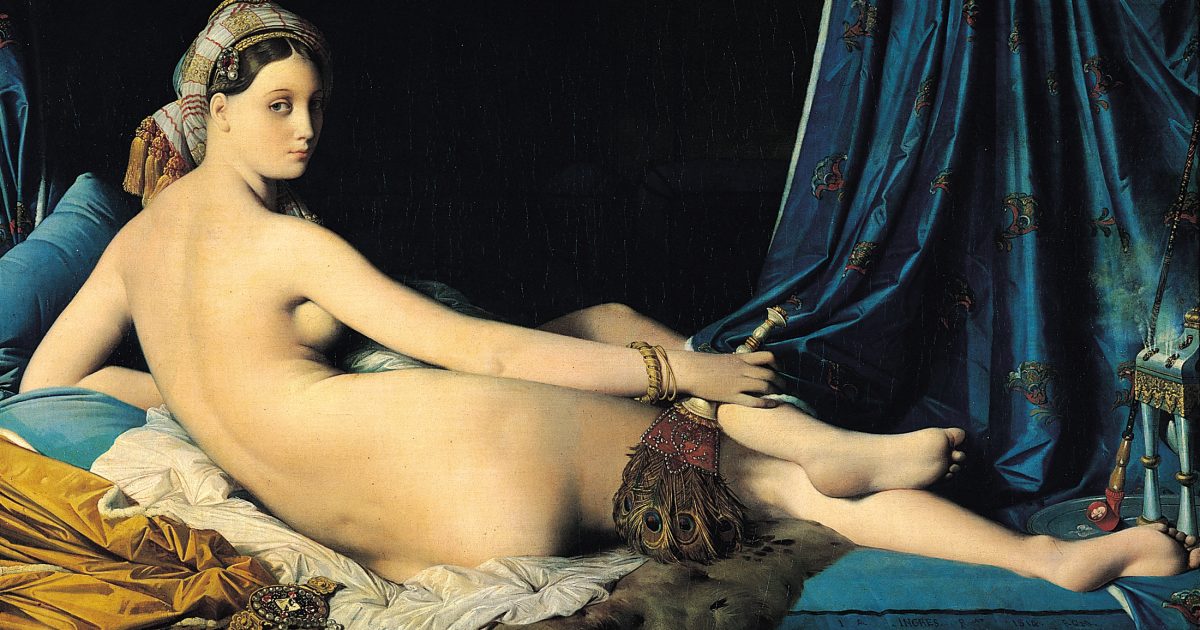
Une odalisque, dite La grande odalisque, 1814, Ingres, Jean-Auguste-Dominique © 2017 GrandPalaisRmn (musée du Louvre) / Franck Raux
A white woman, half-naked, reclining on a couch in a harem: dozens of eighteenth-century paintings depict these “odalisques.” Yet these representations do not correspond to the reality of harems in the Middle East; they almost systematically introduce an exaggerated erotic dimension, with imagined settings and poses. This is hardly surprising when one considers that some of the artists behind these paintings, such as the French painter Jean-Auguste-Dominique Ingres, had never travelled to the Middle East, let alone entered a harem (which, for that matter, were inaccessible to men). Painters and other artists depicting “Oriental” scenes therefore rely on an imagined conception of the Orient, a conception based on their knowledge of it—which is often indirect. As a result, artists do not represent the Orient as it is, but as they would like it to be—whether consciously or unconsciously. This phenomenon is exposed and demonstrated by Professor Edward Said in his book Orientalism (1978).
Since the publication of Orientalism, the world we live in has undergone profound transformations, generating a global crisis of identity and leading to increasingly visible instability. Amid this large-scale upheaval, it becomes essential to understand oneself in order to be able to encounter others. From the moment one engages in such an intellectual exercise, the question arises: is Edward Said’s Orientalism still relevant for understanding Western representations of the Middle East in the twenty-first century?
By specifying what is meant by “Western representations of the Middle East in the twenty-first century” (I), and by examining what Orientalism reveals about the relationship between knowledge and power in the Middle East (II), this essay argues that Said’s concept remains highly relevant: it not only helps us understand contemporary representations (III), but also highlights the extent to which all knowledge is mediated and constructed, leading to a reflection on the role of imagination and the need to critically engage with the representations through which we understand others, particularly in a context marked by identity tensions and the global rise of nationalist logics (IV).
I. Western representations of the Middle East in the twenty-first century
To assess the relevance of Orientalism, it is first necessary to clarify what is meant by “Western representations of the Middle East” in the twenty-first century.
Representations do not emerge in a vacuum; they are constructed from the information we consume. What we see, we register; what we read, we imagine. From there, we classify. We sort by colour, language, tone, narrative, or any other label we can find. In doing so, we constantly build a taxonomy of the world—sometimes consciously, more often not. At that point, we are no longer dealing with a simple presentation of reality, but with its representation. It is a natural human process.
Yet the conditions of this very process are changing radically. The twenty-first century is marked by an epistemic shift driven by the acceleration of transport and the expansion of mass media, enabled above all by the rise of digital networks. Where knowledge was once mediated through limited, curated sources—encyclopaedias, libraries, paintings, museums—it is now produced and circulated instantly through algorithmic feeds and echo chambers. The head of the most powerful army in the current geopolitical landscape (according to Global Firepower) expresses himself constantly, sometimes contradicting himself; active techniques and policies of misinformation are deployed by major states’ intelligence or defence departments; and, as if this were not enough, we are in the midst of the sudden emergence of LLMs, AI models capable of generating textual or visual content almost instantly. And the twenty-first century is only just beginning.
Edward Said’s Orientalism, published in 1978, predates this epistemic revolution. The question, then, is whether this text remains useful for understanding current Western views of the Orient. To do so, it would be too complex, too polemical, and probably impossible to draw up a list of Western views of the Orient belonging to the current century—somewhat like Edward Said did for earlier periods in Orientalism—although there would certainly be things to say about social media, or influencers in Dubai selling dream-like lifestyles. Rather, we will focus on what the methodology of Orientalism can offer: this will allow us to assess the relevance of its addition to an understanding of current views of the Middle East.
II. Edward Said’s methodology
Indeed, Edward Said’s work is not only a brute study of a specific and fixed context—namely, the Western appreciation of the Middle East in modern times, and the way this appreciation has been diverted for political purposes. It is also an intellectual exercise consisting in methodically dissecting the media (mainly books, but also political speeches, for example) transmitting knowledge to those who do not see, and who therefore imagine.
Orientalism, Said argues, serves Western imperialism: by framing the peoples and cultures of the Arabian Peninsula in an essentially reductive and often racist way, “the British political class is able to justify—not only to others, but to itself—its continued support for authoritarian rule in the region” (Wearing 2024, 374). As Said explains, that automatically creates a dichotomy between two relatively monolithic blocs: “we” and “them”, Westerners and Orientals, the “developed” and the “developing” (Said 2003, 46). The object (here, the Orient, the “them”) is defined through negativity: they are different because they lack what “we” have. Even seemingly positivist descriptions—violence, excess, brutal sexuality—ultimately reinforce the same idea: they are not “civilised”. And moreover, these features are often imagined rather than observed.
When Jean-Auguste-Dominique Ingres painted La Grande Odalisque in 1814 (Appendix 1), it was not for political purposes: it was an artistic act, driven by the desire to represent beauty. In a Neoclassical style—that is, a style that aspires to be more rigorous, more rational, and closer to reality—the French painter presents a completely imaginary scene. Here, beauty is beautiful because it reflects the artist’s desire, or rather his representation of desire: to be beautiful, one must be exotic; the Orient is exotic; but since he does not know it, he must render it beautiful according to his own definition of beauty—a white woman, a nude body with firm, well-defined forms, set within a decor that is equally intended to be exotic and conducive to desire, although it does not correspond to the reality of an Oriental woman (Xiao 2025). In other words, the expression of Ingres’s desire is based, like all desire, solely on what he is able to imagine—that is, to represent.
The object thus formed does not correspond to a stable reality, but to a constructed one. This process contributes to identity-building: by assigning characteristics, groups become classifiable. As Said writes, it is possible that such objects “have only a fictional reality.” In other words, “they” (the Orient, and the Orientals) exist for the Europeans in the orientalists’ discourse. This concept of discourse, that Said applies to the Orient, is broader than Orientalism and can be observed in any structured group of individuals; it has been developed by the French philosopher Michel Foucault, in his works Surveiller et punir (1975) and L’Archéologie du savoir (1969). Foucault is mentioned ten times by Said in Orientalism: the latter differs from Foucault by placing greater emphasis on the application of discourse as a deliberate, oppressive calculation, and as a structured colonial force.
The question that follows is therefore this one as put by Said: “Can one divide human reality, as indeed human reality seems to be genuinely divided, into clearly different cultures, histories, traditions, societies, even races, and survive the consequences humanly?” (Said 2003, 45) The danger lies in the essentialisation that follows: reducing a people or culture to fixed traits, that don’t even have to be actual traits, and, in doing so, stripping away its humanity.
III. About the relevance of Orientalism
Having clarified Said’s analysis of discourse and the concept of Orientalism in this context, it is now necessary to assess their relevance for understanding contemporary Western views of the Orient.
Relevance, from the Latin re- (“again”) and levāre (“to lift”), suggests something brought back into importance, something that helps clarify. To ask whether Orientalism is relevant, then, is to ask whether it still helps us understand contemporary Western views of the Middle East. Of course, it remains central in fields such as literature, history, or art. But the real question is whether it can extend beyond that—whether it still matters for the field of international relations more broadly.
As explained in the first part above, if one focuses solely on Said’s study of Orientalism between the eighteenth and twentieth centuries, it does not fully correspond to our contemporary reality, not least because the balance of power has changed: Said focused primarily on France and England; by the end of World War I, Europe had colonised 85% of the world (Said 2003, 123). Today, we are (arguably) in a post-colonial era, and the balance of power has shifted towards the United States and China. However, even if Edward Said focuses on specific cases and selects sources to support his argument—as critics like Robert Irwin have pointed out (Irwin 2007)—his contribution lies less in his examples than in his approach, as explained in Part II above. His methodology consists in systematically questioning the structures of knowledge that surround us. It invites us to examine not only cognitive biases, but also the very content we inherit as “knowledge.” It highlights the emergence of a self-fulfilling loop: representations shape expectations, expectations shape reality, and reality then confirms the initial representation.
Applied to the Middle East, the mechanism is clear: the region is portrayed as violent; policies and attitudes begin to treat it as inherently violent; and these responses, in turn, reinforce the image. Even without explicit intention, knowledge becomes structured by—and contributes to—relations of power. Viewers of Ingres’s painting will develop their representation of the Orient based on his: the loop is closed. When the American President Donald J. Trump speaks of transforming the Gaza Strip into the “Riviera of the Middle East” (Baker 2025), this is not related to any reality of the geographical characteristics of Gaza or of the populations living there: it is merely the expression of a Western desire—a beachfront hotel where one can relax in the sun. By generating a mock-up video of such a scene and sharing it with a wide audience, Trump disseminates a representation (however absurd it may be) to some audiences whose perception of the Middle East will be influenced, shaped by his representation.
The new main issue is that, in the context of informational abundance described above, the impulse to classify becomes central. The gap between representations and realities widens, producing forms of essentialisation. By reading and writing, we do not merely observe this system—we participate in it, often without noticing. In that sense, questioning knowledge itself—following Said’s example in Orientalism—becomes not only relevant, but necessary. That said, such a posture cannot be constant. Every work is biased; every piece of knowledge carries traces of power; each type and character belongs “to a system, a network of related generalizations” (Said 2003, 121). Indeed, at this initial phenomenon is added “a complex dialectic of reinforcement”: what readers experience is shaped by what they have read, which in turn pushes writers to focus on subjects already defined by those experiences. Said illustrates that with the example of the lion (Said 2003, 94): a book on how to handle a fierce lion can thus lead to a whole series of works about the fierceness of lions, its origins, and its forms. Gradually, the focus shifts—from the lion itself to its fierceness. And ironically, the methods proposed to manage that fierceness end up reinforcing it, locking the lion into that single trait, as if it were all we can—or are allowed to—know about it.
IV. About the role of imagination in geopolitics
Reading shapes—and inevitably distorts—our understanding of the world. However, abandoning it is neither possible nor desirable: imagination, despite its biases, is precisely what allows us to grasp and rethink geopolitical realities.
To read, or not to read—that becomes the question. Every piece of writing will influence the reader. It does not need to be willingly biased: it will be. Even the most “objective” work reflects the limits of its author—their knowledge, their context, their field of action. What we read, we imagine; and what we imagine does not correspond directly to reality, but to a representation. This applies at every scale: from interpreting the emotions of a child who cannot yet speak, to grasping the complexity of an entire region such as the Middle East, or even broader concepts such as life or death. These gaps are inevitable. However, they become problematic in a geopolitical context, when those who hold power act upon such representations and reshape realities accordingly. As Edward Said shows, the Orient was first “known”, then “invaded” and “possessed”, before being re-created in order to be governed.
Should we then stop reading? Such a conclusion would be both impractical and counterproductive. The issue is not that knowledge is useless, but that it is always mediated and imperfect. Reading exposes us to representations, which inevitably distort—but also make imagination possible. To imagine is not only to misrepresent; it is also to project, to rethink, and to transform. In that sense, imagination plays a central role in international relations: it shapes how actors perceive others, anticipate their behaviour, and define possible futures. The challenge, therefore, is not to reject representation, but to multiply perspectives—through texts, contradictions, and encounters. “To dream you don’t have to close your eyes, to dream you have to read” wrote Foucault: reading is not an escape from reality, but a way of producing it.
This becomes even more pressing in a context of identity tensions. When identities feel unstable, individuals and groups tend to turn inward, redefining themselves against others, and mechanically defining the others against themselves. As Victor Hugo observed, “Au siècle de Louis XIV on était helléniste, maintenant on est orientaliste.” Today, one might add: increasingly, we are nationalist. In such moments, the world is simplified, and the opposition between “us” and “them” is reinforced—whatever the “us” and “them” are. What emerges is a broader pattern: the continuous production of difference through representation, which shapes not only how others are perceived, but how we (mis)understand ourselves.
Conclusion
This essay began with a simple observation: what we see is never reality itself, but a representation shaped by imagination. From Orientalist paintings to contemporary media, the Middle East has long been constructed through indirect knowledge, often reflecting more about those who represent than about what is represented. Edward Said’s Orientalism allows his readers to move beyond this observation by exposing the mechanisms behind such constructions: the production of knowledge as a form of power, the creation of a divide between “us” and “them,” and the gradual transformation of imagined traits into perceived realities. While the historical context he studies differs from the twenty-first century, his method—questioning how knowledge is produced, transmitted, and internalised—remains relevant. Applied to the current period, it reveals a world where representations circulate faster, multiply endlessly, and increasingly shape the realities they claim to describe. In that sense, to read, to watch, to imagine, is never neutral: it is already to participate in the construction of the world.
As Edward Said himself acknowledges, Orientalism “did a great many things”: it produced scholars, expanded linguistic knowledge, and fostered genuine intellectual curiosity towards the cultures it studied (Said 2003, 96). Yet—and this is the crucial point—“Orientalism overrode the Orient.” The danger, therefore, does not lie in the existence of representations, but in the moment they become self-sufficient, when they cease to be tools for understanding and instead insidiously impose themselves as reality. What is at stake is not imagination itself, but its closure: the moment when representation stops pointing beyond itself and begins to define what can be thought.
In the twenty-first century, this dynamic does not disappear—we could argue that it intensifies. The sheer volume of information, the logic of algorithms, and the emergence of technologies capable of generating narratives almost instantly all contribute to reinforcing this gap between representation and reality. But this is precisely why Said’s and Foucault’s approaches remain relevant. Not because they describe our world exactly as it is, but because they teach us how to read it.
Bibliography
Baker, Peter. 2025. ‘An Unbound Trump Pushes an Improbable Plan for Gaza – The New York Times’. The New York Times, February 5. https://www.nytimes.com/2025/02/05/us/politics/trump-gaza-netanyahu-takeover.html.
Foucault, Michel. 1967. ‘La Bibliothèque fantastique’. Cahiers Renaud Barrault (Paris) 59 (Flaubert): 5–31.
Foucault, Michel. (1975) 1993. Surveiller et punir: naissance de la prison. Collection Tel 225. Gallimard.
Foucault, Michel. (1969) 2008. L’archéologie du savoir. Collection Tel 354. Gallimard. Reprint, Gallimard.
Irwin, Robert. 2007. For Lust of Knowing: The Orientalists and Their Enemies. Penguin Books.
Said, Edward W. 2003. Orientalism. Facsimile edition. Penguin Modern Classics. Penguin.
Wearing, David. 2024. ‘The Myth of the Reforming Monarch: Orientalism, Racial Capitalism, and UK Support for the Arab Gulf Monarchies’. Politics 44 (3): 370–85. https://doi.org/10.1177/02633957211041547.
Xiao, Jade. 2025. ‘The Skin of the Orient: Representation of the “Oriental Woman” in Jean-Auguste Dominique Ingres’ Odalisque, Enslaved Woman, and Eunuch’. Canvas Journal, November 13. https://www.canvasjournal.ca/read/the-skin-of-the-orient-representation-of-the-oriental-woman-in-jean-auguste-dominique-ingres-odalisque-enslaved-woman-and-eunuch.